


 PLATFORM UPDATE:

Enhanced negative electrocaloric effect in Sn-doped PbHfO3 films through phase transition induction
 *a
*a
Abstract
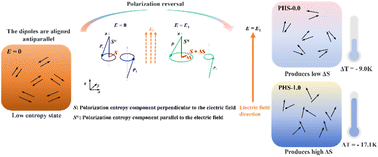
The increasing integration of electronic chips driven by artificial intelligence leads to escalating heat dissipation problems, severely limiting the reliability of micro-devices. Solid-state cooling technology based on the negative electrocaloric effect (NECE) provides a promising pathway to overcome the chip cooling bottleneck. In this work, PbHf1−xSnxO3 films (PHS-100x) with excellent NECE, which are promising for refrigeration applications, were successfully fabricated. Research reveals that by incorporating Sn4+, the structural disorder within the PbHfO3 film is notably enhanced, leading to an improved polarization response and a reduced energy barrier for the antiferroelectric-to-ferroelectric (AFE–FE) phase transition, thereby effectively enhancing the NECE. The study shows that compared to the PHS-0.0 sample (ΔT = −9.0 K), the sample with 1 mol% Sn4+ doping (PHS-1.0 film) exhibits a greatly enhanced NECE (90% enhancement), achieving a maximum isothermal entropy change (ΔS = 15.2 J K−1 kg−1) and a large adiabatic temperature change (ΔT = −17.1 K) at 45 °C under 645 kV cm−1. Additionally, the PHS-1.0 film exhibits a positive electrocaloric effect (PECE) in a high-temperature environment, with ΔT reaching 18.3 K. The emergence of this effect offers a potential breakthrough beyond the cooling efficiency limitations of the single electrocaloric effect (ECE). By incorporating it with the NECE in refrigeration cycles, a novel pathway has been established for enhancing cooling performance. This research explores a promising new candidate material for electrocaloric cooling technology.
 Please wait while we load your content...


