


 PLATFORM UPDATE:


On the electrostatic boundary effect: key influencing factors and underlying mechanisms in patterned triboelectric sensors
 *a
*a
Abstract
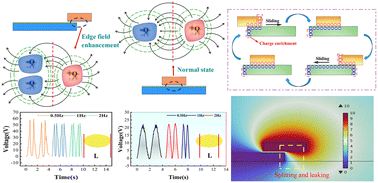
The performance of triboelectric nanogenerators (TENGs) is contingent upon the electrostatic field distribution characteristics of their sensing electrodes. It is imperative to acknowledge the critical role played by field distortion, stemming from the effects at the boundaries, in determining the sensitivity and stability of the system's output. The present study systematically investigates the regulatory mechanisms governing slider width and electrode patterning design, with a view to elucidating the impact of electrostatic boundary effects. Through theoretical modelling and electrostatic simulations, it was demonstrated that an increase in the width of the slider effectively suppresses edge-induced field distortion and reduces charge density gradients. This in turn mitigates the impact of the boundary effect on sensor performance. Concurrently, the introduction of electrodes with curved geometric patterns – such as elliptical or parabolic contours – enables the strategic redistribution of edge electric fields. This approach serves to minimise the interference between the electrodes, thereby enhancing the accuracy of the dynamic response. The experimental findings demonstrate that the optimisation of electrode curvature design, in conjunction with the synergistic regulation of slider width, effectively suppresses electrostatic boundary effects. This, in turn, enhances the stability of sensor performance.
 Please wait while we load your content...


