


 PLATFORM UPDATE:


OSC-Net: a multi-fidelity machine learning model for organic solar cells

Abstract
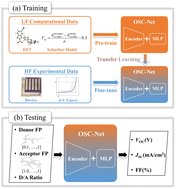
Organic solar cells (OSCs) have emerged as a promising renewable energy technology, offering advantages such as lightweight design, semitransparency, flexibility, and cost-effectiveness. Power conversion efficiency (PCE) is a key device performance parameter for OSCs, defined as the ratio of the electrical power output generated by the device to the incident solar power input. Despite significant advances, the development of high-performance OSCs remains a labor-intensive process, heavily dependent on expert experience, involving extensive synthesis, characterization, and iterative optimization. Data-driven methods offer a promising alternative for accelerating material discovery, but their effectiveness is often limited by the scarcity of high-quality experimental data. To overcome this challenge, we propose OSC-Net, a multi-fidelity machine learning framework that integrates a large volume of computational data with a smaller set of high-accuracy experimental measurements. This approach enables accurate prediction of key device performance parameters, including PCE, while simultaneously tackling the challenges associated with experimental data scarcity and uncertainty quantification, enabling efficient screening of OSC materials. Importantly, the predictive capability of OSC-Net was verified against published experimental data, confirming its accuracy and reliability. By leveraging both data sources, OSC-Net achieves superior predictive performance compared to conventional single-fidelity models. Furthermore, the uncertainty quantification captures variability in the model, enhancing the reliability of predictions. Finally, OSC-Net was employed for large-scale high-throughput screening, successfully identifying promising candidates with high predicted PCEs that were validated against literature-reported experimental data. Thus, OSC-Net presents a feasible approach for rapid and accurate inference of device performance parameters with limited experimental datasets, enabling efficient OSC material discovery.
 Please wait while we load your content...


