


 PLATFORM UPDATE:


Cracking behavior of upgraded waste plastic pyrolysis oil to lighter olefins (C2–C3): a study on performance, product distribution and outlook for a circular hydrocarbon economy
 *ab
*ab
Abstract
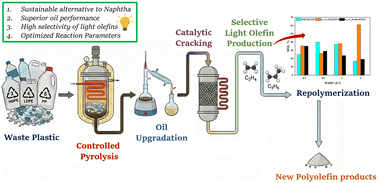
Circularity in plastic waste management is still a major challenge due to the heterogeneous nature of plastic waste streams, which find use in generators but face restrictions in wider applications. Chemical upgradation of plastic pyrolysis oil offers a practical route to improve fuel compatibility and usability. The proposed treatment approach shows flexibility across different feedstock conditions, supporting its relevance for closed-loop plastic recycling. This study investigates the catalytic cracking of upgraded waste plastic pyrolysis oils (PPO), including chemically treated (CPO) and distilled (DPO) pyrolysis oils. Cracking was done using Equilibrium Catalyst (E-CAT) in a fixed-bed reactor, operating within the temperature range of 500 °C to 600 °C to produce light olefins (C2–C3). The influence of DPO, CPO, and PPO on product distribution and catalyst performance is examined. The findings reveal that DPO yields the highest cracking toward light olefins, with a yield of 61.1 mol% at 550 °C and a WHSV of 2 h−1 as compared to CPO and PPO. In contrast, CPO and DPO resulted in higher conversions of methane (26.4 mol% and 25.7 mol%, respectively), followed by the lowest in DPO (17 mol%). Time-on-stream analysis (TOS) revealed that DPO's lighter olefin conversion has declined, particularly in ethylene yield from 31.09 mol% to 12.13 mol% over time as compared to CPO, which maintained an ethylene yield of 23.5 mol%. This study contributes to the prospect of upgraded PPO as an alternative to naphtha feed under optimized reaction conditions, such as temperature and WHSV, for high yields of olefins in a petrochemical unit.
 Please wait while we load your content...


