


 PLATFORM UPDATE:

Data-driven approach to elucidate the correlation between photocatalytic activity and rate constants from excited states
 a
Naoto
Inai,
a
Naoki
Noto,
*c
Takuya
Ogaki,
d
Yasunori
Matsui,
d
Hiroshi
Ikeda,
d
Olga
García Mancheño,
b
Takeshi
Yanai
*ae
and
Susumu
Saito
*ac
a
Naoto
Inai,
a
Naoki
Noto,
*c
Takuya
Ogaki,
d
Yasunori
Matsui,
d
Hiroshi
Ikeda,
d
Olga
García Mancheño,
b
Takeshi
Yanai
*ae
and
Susumu
Saito
*ac
Abstract
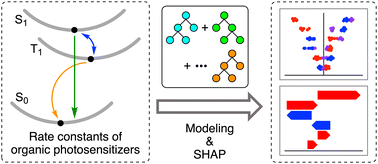
Even though excited-state properties play a crucial role in photocatalysis, directly correlating these with photocatalytic activity remains challenging. Herein, we propose a method to elucidate the correlations between the catalytic activity of organic photosensitizers and the rate constants of various excited-state processes through integrating machine learning (ML), quantum chemical calculations, and chemical experiments. This approach was applied to interpolative predictions of the yield of the nickel/photocatalytic formation of C–O bonds and radical additions to alkenes using various organic photosensitizers with satisfactory accuracy (R2 = 0.83 and 0.77 on the test set, respectively). The calculated rate constants obtained through quantum chemical calculations proved to be comparable or even superior to the experimentally measured excited-state lifetimes as descriptors. SHAP-based visual analysis revealed that the rate constants corresponding to transitions from the T1 state provide significant contributions to the interpolative prediction of photocatalytic activity. Additionally, the non-radiative decay process between the S1 and S0 states helps describe the low catalytic activity of poorly emissive photosensitizers. These findings highlight the potential of the proposed method to provide insights into photocatalytic properties that are difficult to obtain using conventional approaches.
- This article is part of the themed collection: 2026 Chemical Science Covers
 Please wait while we load your content...


