


 PLATFORM UPDATE:


Frontiers in manganese catalysis: a sustainable platform for bond construction and heterocycle synthesis
 *a
Sumit Kumar
Panja,
e
*a
Sumit Kumar
Panja,
e
Abstract
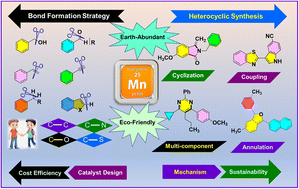
The progress of earth-abundant transition metal-based catalytic methodologies has driven growing interest within the scientific community for the construction of bioactive organic molecules. Among the earth-abundant transition metals, manganese is an attractive alternative to precious metals in synthetic methodologies due to its availability, low toxicity, and variable oxidation states. Recently, there has been considerable progress in manganese catalysis for the selective formation of diverse chemical bonds. This review introduces recently developed techniques in manganese catalysis for various bond-forming strategies, especially C–N, C–C, C–O, and C–S bonds, indicating the importance of manganese-based methods in organic syntheses. Manganese-catalysed methodologies have also demonstrated considerable efficacy in the construction of heterocyclic moieties. The synthesis of heterocyclic compounds through manganese-based annulation, cyclization, and multicomponent techniques is briefly summarized in this review. We also discuss the main catalytic structures, reaction variables, ligand considerations, substrate scope, and functional group tolerance, and the importance of manganese catalysis in terms of both economic viability and sustainability. The need for eco-friendly manganese catalysts that can promote both diverse bond-forming approaches and the construction of heterocyclic moieties further accentuates their emerging importance in modern synthetic methodology.
 Please wait while we load your content...


