


 PLATFORM UPDATE:


Development of a multi-targeted sulfonyl-bridged bisselenadiazole derivative as a potent EGFR/PI3K/AKT/mTOR modulator in lung adenocarcinoma
 d
Reda F. M.
Elshaarawy
*e
and
d
Reda F. M.
Elshaarawy
*e
and
Abstract
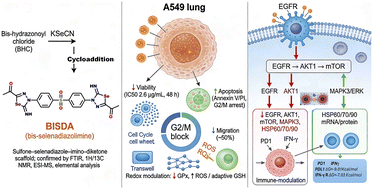
Lung adenocarcinoma (LUAD), the most common type of non-small cell lung cancer (NSCLC), requires multi-targeted therapies to overcome resistance mechanisms and reduce toxicity. Herein, we synthesize and characterize a new sulfonyl-bridged bis(1,3,4-selenadiazole) derivative (BISDA) containing four pharmacophores that potently inhibits LUAD cell proliferation. BISDA displayed 48-h IC50 of 2.609 µg mL−1 in A549 cells, decreased viability compared to controls, and was less toxic than cisplatin while inducing apoptosis, G2/M cell cycle arrest, and inhibiting cancer cell migration. BISDA remodels the redox environment by reducing glutathione peroxidase activity, and increasing intracellular glutathione levels, leading to increased PD-1 and reduced IFN-γ expression. It further downregulated prominent oncogenic drivers, EGFR, AKT1, MAPK3, mTOR, TGF β, HSP60, HSP70 and HSP90, targeting proliferation and survival with stress response in the context of metastasis. Principal component analysis showed that BISDA reprogrammed signaling through decoupling of the EGFR–mTOR axis from the TGFβ–AKT1–MAPK3–HSP90 cluster, indicative of a global rewiring of pathways. These results suggest that BISDA may serve as a multifaceted inhibitor for treating LUAD, acting in an antiproliferative capacity through apoptosis induction while also preventing signaling pathways associated with resistance.
 Please wait while we load your content...


