


 PLATFORM UPDATE:


On the thermal stability and surface and catalytic properties of Ag–Ni nanoparticles

Abstract
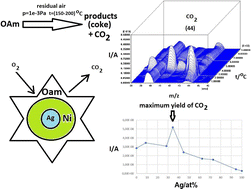
Nanoparticles, due to their unique size-dependent properties, distinct from those of bulk materials, have become a rapidly developing and intensively studied area of chemistry. These properties include the ability to catalyse chemical reactions, reduced melting temperatures, and distinctive optical characteristics. In this paper, we investigate these features in bimetallic Ag@Ni core–shell nanoparticles of varying composition. The nanoparticles were synthesised via a solvothermal method using silver nitrate and nickel(II) acetylacetonate in a mixture of oleylamine and octadec-1-ene as solvents. Characterisation was carried out using a series of spectroscopic and microscopic methods. Catalytic activity and surface processes leading to the production and release of carbon dioxide were examined using Knudsen effusion mass spectrometry (KEMS). The highest catalytic activity was noted for Ag–Ni nanoparticles containing approximately 30–50 at% silver. The catalytic process is accompanied by the formation of organometallic compounds, which were detected by X-ray photoelectron spectroscopy (XPS) and laser ablation-inductively coupled plasma mass spectrometry (LA-ICP-MS). Thermal stability during heating was evaluated by differential scanning calorimetry (DSC), and a melting point depression of approximately 10 °C was observed for all studied samples. The paper is a part of a broader study of Ni-based bimetallic nanoparticles, their thermal stability and catalytic activity.
 Please wait while we load your content...


