


 PLATFORM UPDATE:


Design, synthesis, and enzyme kinetic evaluation of oxadiazole derivatives as nucleoside triphosphate diphosphohydrolase (NTPDase) inhibitors: an integrated in vitro and in silico approach
 *b
Muhammad
Latif
*bgh
*b
Muhammad
Latif
*bgh
Abstract
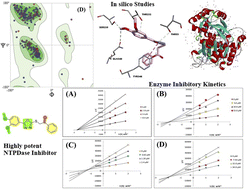
Given the pivotal function of ecto-nucleoside triphosphate diphosphohydrolases (ecto-NTPDases) in cancer progression and purinergic signaling, the identification of potential small heterocyclic inhibitors has become a significant objective in medicinal chemistry campaigns. This study concentrated on the development of substituted oxadiazole derivatives as ecto-NTPDase inhibitors. A series of 1,3,4-oxadiazole derivatives (4, 7a–7g) were synthesized and assessed for their in vitro inhibition and in silico potential against ecto-NTPDases. In silico studies were conducted to predict pharmacokinetic properties using two different online tools, pkCSM and SwissADME. The results indicated favorable safety profiles with minimal or no toxicity and almost no pharmacokinetic violations. Molecular docking studies demonstrated that the 1,3,4-oxadiazole series selectively inhibited ecto-NTPDases with notable affinity toward NTPDase2, which is implicated in tumorigenesis and cancer progression. Structural interaction fingerprint (SIFt) analysis revealed that the binding affinities of the synthesized 1,3,4-oxadiazole derivatives with amino acid residues in the active binding site were higher than those of Amp and Anp redocked standards, which exhibited binding interactions with water molecules. Density functional theory (DFT) revealed the top docking hits and best inhibitors, further corroborating their stability and electronic suitability for enzyme inhibition. The successful synthesis of the target heterocycles was confirmed by FTIR and 1H- and 13C-NMR spectral analyses. Ecto-NTPDase inhibition and structure–activity relationship (SAR) studies indicated that 7g was an excellent inhibitor of all isoforms, followed by 7d and 7c for NTPDase3 and NTPDase8, respectively. Kinetic inhibitory studies revealed that the best inhibitor, 7g, exhibited non-competitive inhibition against NTPDase1 and 2 and mixed inhibition against NTPDase3 and 8. The Michaelis–Menten constants and inhibition constants of 7g against NTPDase1 and 2 were Km 0.028 µM, Ki 0.022 µM and Km 0.02 µM, Ki 0.015 µM respectively. On the other hand, the inhibition constants of 7g against NTPDase3 and 8 were Ki 1.13 µM and Ki 12.4 µM respectively. This study provides a robust foundation for the development of 1,3,4-oxadiazoles as potential inhibitors of ecto-NTPDases, particularly NTPDase2.
 Please wait while we load your content...


