


 PLATFORM UPDATE:


Hinokitiol-fueled disks form exclusionary zones in the presence of iron

Abstract
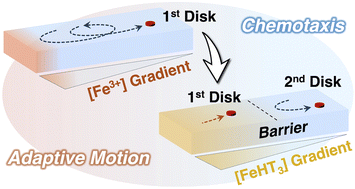
Stimuli-responsive, directional motions, such as chemotaxis, are vital for the development of sophisticated synthetic systems with autonomous motility. Here, we demonstrate that disks containing hinokitiol exhibit directional self-propelled motion on water in response to metal ions, particularly Fe(III) ion. The self-propelled motion arises from surface tension gradients at the air-water interface, generated by the asymmetric release of hinokitiol, which induce Marangoni flows that propel the disks. Upon contact with Fe(III), hinokitiol forms a highly surface-active complex that locally lowers the surface tension and establishes a persistent interfacial gradient. This localized accumulation of the iron complex acts as a chemo-repulsive signal, directing the disks away from iron-rich regions and leading to the formation of exclusionary zones that influence the trajectories of subsequent disks. These findings demonstrate how self-secreted chemical signals can generate interfacial memory and communication in macroscopic active systems, providing a molecular design principle for life-like collective behavior.
 Please wait while we load your content...


