


 PLATFORM UPDATE:


Length-dependent quantum interference and high thermoelectric response ferrocene-modified OPE wires

Abstract
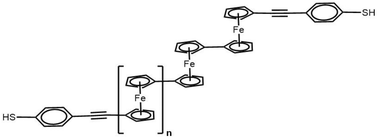
We present a study of the length-dependent charge transport properties of a homologous series of oligo(phenylene–ethynylene) (OPE) molecular wires integrated with ferrocene units (Fe 1–Fe 5). Theoretical analysis reveals a coherent, length-dependent transport mechanism governed by quantum interference, with a distinct odd–even parity effect. Molecules with an odd number of ferrocene units exhibit a characteristic transmission dip within the HOMO–LUMO gap, a signature of destructive quantum interference (DQI), while even-numbered molecules show constructive quantum interference (CQI). This demonstrates that the interference behaviour is a holistic property of the full molecular length, not merely of the ferrocene core. The series exhibits efficient long-range tunneling, with a decay constant of β ≈ 1.1 nm−1 over lengths from 1.98 to 3.47 nm. Furthermore, these structures also possess high thermoelectric potential, with calculated Seebeck coefficients exceeding 250 µV K−1. The ability to switch between DQI and CQI states through molecular parity, combined with low conductance attenuation and high thermopower, establishes this ferrocene-OPE architecture as a highly promising platform for designing tuneable molecular electronic and energy conversion devices.
 Please wait while we load your content...


