


 PLATFORM UPDATE:


Interfacial charge transfer-driven UV-activated photocatalytic degradation of metronidazole via δ-MnO2/WO3 heterojunction in aqueous media
 *a
*a
Abstract
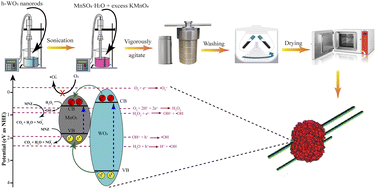
Pharmaceutical contaminants, particularly recalcitrant antibiotics such as metronidazole (MNZ), are removed from water by engineering an efficient UV-driven δ-MnO2/WO3 nano-heterojunction photocatalyst to reduce public health risk and restore ecosystems. In this study, a novel hierarchical nanocomposite photocatalyst was synthesized via a facile two-step hydrothermal route with unique “flower-rod” architectures. Structural and surface analyses confirm the presence of pure δ-MnO2 and hexagonal WO3, as well as reveal the coherent interfaces between the flower-shaped δ-MnO2 and rod-shaped hexagonal WO3. The nanocomposite exhibited reduced crystallite size, higher micro-strain, and defect-rich surfaces compared to pure phases, which are favorable for charge trapping and adsorption. UV-Vis diffuse reflectance spectroscopy detected broad UV-visible absorption and a slight band gap widening upon coupling, while band-edge calculations indicated a type-I alignment between δ-MnO2 and WO3. The photocatalytic performance assessed by the MNZ degradation under UV light irradiation demonstrated that the δ-MnO2/WO3 (5%) photocatalyst achieved ∼82% degradation within 100 min at an optimal dosage of 0.5 g L−1 and pH 11, outperforming pristine δ-MnO2 and WO3. The corresponding pseudo-first-order rate constant (0.01541 min−1) and electrochemical impedance spectroscopy revealed evidence of fast kinetics, lower charge-transfer resistance, and more efficient separation of photogenerated carriers. These results emphasize δ-MnO2/WO3 nano-heterojunctions as a promising and highly efficient photocatalytic treatment for antibiotic-contaminated wastewater.
 Please wait while we load your content...


