


 PLATFORM UPDATE:


Differentiation of β-phosphorylated nitroxide diastereoisomers by complexation with cyclodextrins: an EPR and cyclic voltammetry study
 *ab
Gabriela
Ionita
*a
*ab
Gabriela
Ionita
*a
Abstract
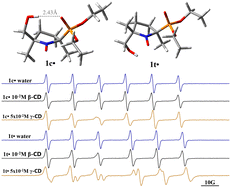
The complexation of two diastereoisomers of a β-phosphorylated cyclic nitroxide radical (2,5-dimethyl-5-hydroxymethylene-2-diethoxyphosphonyl-pyrrolidin-N-oxyl) with cyclodextrins (β-CD and γ-CD) was investigated using electron paramagnetic resonance (EPR) spectroscopy and cyclic voltammetry. The two isomers have different EPR signatures due to the differences in their phosphorus and nitrogen hyperfine splitting constants. The cis stereoisomer (1c˙) promotes intramolecular hydrogen bonding, involving the HO group attached to the methylene group and O atom from the phosphorus moiety, while in the case of the trans stereoisomer (1t˙), this intramolecular bonding is not possible. The EPR spectra indicate the higher affinity of the 1t˙ isomer for γ-CD, highlighting the different EPR parameters of the free radical and complexed radical. The binding constants determined based on the EPR and cyclic voltammetry data show stronger affinity for γ-CD compared with β-CD, particularly for 1t˙. An increasing potassium chloride concentration enhances the stability of the complex linearly by modulating the solvation and electrostatic interactions, as indicated by the thermodynamic parameters obtained from EPR measurements. Electrochemical measurements demonstrate decreased diffusion coefficients and anodic peak shifts upon complexation, supporting the spectroscopic results. These findings highlight the important role of molecular stereochemistry and ionic strength in modulating host–guest interactions between cyclodextrins and nitroxides.
 Please wait while we load your content...


