


 PLATFORM UPDATE:


Solvation of copper(ii), zinc(ii) and lead(ii) in monoethanolamine solutions attained via leaching of microwave-assisted-roasted sulfidic tailings

Abstract
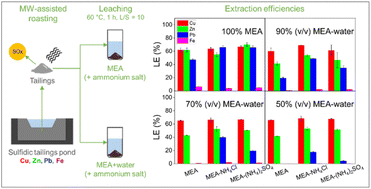
Solvometallurgical leaching using lixiviants based on monoethanolamine (MEA) was investigated for extracting copper, zinc, and lead from sulfidic tailings that underwent an optimized short microwave-assisted roasting pre-treatment. The addition of 0.5 M ammonium sulfate to the MEA solvent increased the extraction efficiencies for all targeted metals, as it provided charge balancing for the cationic metal–MEA complexes. Similar extraction efficiencies were found for copper (∼67%), zinc (70%), and lead (∼66%), highlighting the capability of the MEA-based lixiviant to dissolve the anglesite phase (PbSO4) present in the roasted tailings, which is poorly soluble in pure water (∼1.5%). Additionally, microwave-assisted leaching at a high temperature (of 150 °C) increased the degree of dissolution of the remaining unroasted sphalerite phases (ZnS), but decreased the leaching yield for copper. Furthermore, addition of water to the MEA solvent did not affect the copper and zinc leachability at 60 °C but lowered the dissolution of lead and iron. The dissolution behavior of metals salts in MEA–water mixtures was fostered by experimentally determining the Gibbs free energy of transfer values, which in turn were compared with theoretical binding energies obtained via Density Functional Theory (DFT) calculations. DFT calculated binding energies compared well with the experimental Gibbs free energy of transfer for the dissolution of metal salts in MEA–water mixtures, entailing that the complex binding energy has a strong contribution to the overall dissolution of Gibbs free energy of the metal cations in the studied solvents.
 Please wait while we load your content...


