


 PLATFORM UPDATE:


Morphology-driven oxygen evolution performance of NiOx nanostructures and implications for hole transport in perovskite solar cells
 a
Can
Li,
b
Bipin
Rijal,
c
Mahesh
Nepal,
c
Tara P.
Dhakal,
*ac
Shyam
Kattel
*f
and
Jiye
Fang
*ab
a
Can
Li,
b
Bipin
Rijal,
c
Mahesh
Nepal,
c
Tara P.
Dhakal,
*ac
Shyam
Kattel
*f
and
Jiye
Fang
*ab
Abstract
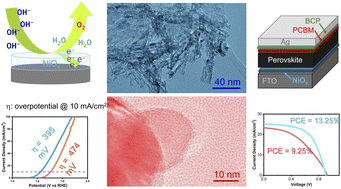
Morphology-controlled nanostructures provide an effective strategy to modulate both oxygen evolution reaction (OER) activity and photovoltaic performance in perovskite solar cells (PSCs). However, achieving low OER overpotentials and high power conversion efficiency (PCE) simultaneously through morphology engineering remains challenging. In this work, nickel oxide (NiOx) nanostructures with spindle-like (NiOx-NS) and plate-like (NiOx-NP) morphologies were synthesized and evaluated as bi-functional OER catalysts and hole transport layers (HTLs) in inverted PSCs. Structural and thermal analyses reveal that NiOx-NS crystallizes into a cubic phase at a lower temperature (300 °C), whereas NiOx-NP requires higher calcination temperatures, reflecting differences in precursor microstructure. Electrochemical measurements indicate that NiOx-NS calcined at 300 °C delivers the lowest OER overpotential (395 mV at 10 mA cm−2), outperforming NiOx-NP calcined at 400 °C (565 mV) and 500 °C (474 mV). This enhanced activity is ascribed to favorable surface strain, increased defect density, and advantageous facet exposure. When used as HTLs, NiOx-NS also delivers the highest PCE (13.25%) among all tested devices, exceeding those based on NiOx-NP and commercial NiOx, owing to improved hole extraction and interfacial contact. Overall, this study highlights the importance of morphology control and thermal processing in tailoring NiOx for multifunctional nanomaterials in electrocatalytic and photovoltaic applications.
 Please wait while we load your content...


