


 PLATFORM UPDATE:


An investigation on the electrochemical performance of Mn3O4-based aqueous symmetric supercapacitor devices

Abstract
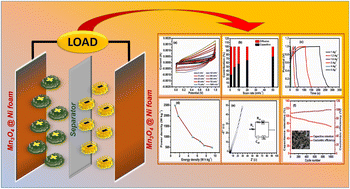
Manganese (II, III) oxide (Mn3O4) is one of the promising materials in the realm of high-performance supercapacitors. The high theoretical specific capacitance, low cost, non-toxicity, environmental compatibility, and natural abundance made it significant in the research field. A low-temperature hydrothermal synthesis method was adopted to prepare Mn3O4 (hausmannite) nanoparticles with a tetragonal spinel structure. The as-prepared nanoparticles were assessed for the structural, elemental, electrical, optical and nitrogen adsorption–desorption studies through XRD, FTIR, Raman spectroscopy, XPS, DC conductivity, UV-vis absorption and BET analyses. Morphological studies were done using FESEM and TEM and a mixture of nanorods and nanocubes were observed. The electrochemical performances of the as-prepared Mn3O4 nanoparticles were investigated by cyclic voltammetry (CV), galvanostatic charge/discharge (GCD) method and electrochemical impedance spectroscopy (EIS) in a three-electrode system. The present work reports the fabrication of a prototype aqueous symmetric supercapacitor device for the first time. The electrochemical studies were performed in 0.5 M Na2SO4 electrolyte on the separator with a potential window of 0 V to 1 V. A specific capacitance of 68 Fg−1 at a current density of 1 Ag−1 was observed from the constant charge/discharge method. It exhibited a cyclic stability of 72% with a coulombic efficiency of 100% after 1000 cycles. This underscores the noteworthy role of manganese oxide nanoparticles as electrode materials in supercapacitors.
 Please wait while we load your content...


