


 PLATFORM UPDATE:


Engineering a CeO2–ZnO nanocomposite on biochar for synergistic adsorption-photocatalysis and enhanced multipollutant wastewater remediation

Abstract
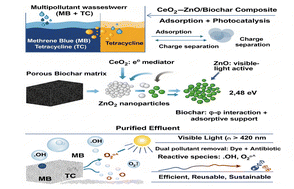
This study presents a novel CeO2–ZnO/biochar (CeZB) ternary composite, synthesized via a straightforward hydrothermal method, and investigates its dual functionality in the adsorptive removal and photocatalytic degradation of multiple wastewater pollutants. Structural and morphological analyses confirmed the successful incorporation of CeO2 and ZnO nanoparticles onto the biochar support, which enhanced the surface area and availability of active sites. The resulting composite exhibited a high specific surface area of 215.3 m2 g−1 and a bandgap energy of 2.48 eV, making it capable of visible-light-driven photocatalysis. Within 60 minutes, the CeZB composite showed good adsorption capability for methylene blue (MB, 198.6 mg g−1) and tetracycline (TC, 163.2 mg g−1) at pH 7. Under simulated solar irradiation, photocatalytic degradation efficiencies reached 96.5% for MB and 91.3% for TC within 90 minutes. Enhanced charge separation, reactive oxygen species (ROS) production, and π–π interactions enabled by the biochar matrix were identified as the synergistic mechanism. Kinetic and equilibrium analyses indicated that the adsorption process is governed by monolayer chemisorption, as evidenced by its strong conformity to the Langmuir isotherm model and the pseudo-second-order kinetic model, with correlation coefficients exceeding 0.99. The rate constants for the photocatalytic degradation were 0.031 min−1 for MB and 0.027 min−1 for TC, indicating pseudo-first-order kinetics. The composite's stability was confirmed by reusability tests conducted over five cycles, which revealed a minor reduction in performance (<6%). All things considered, the CeZB ternary composite offers a viable and sustainable method for using combined adsorption-photocatalysis to treat complex wastewater that contains both dyes and antibiotics.
 Please wait while we load your content...


