


 PLATFORM UPDATE:


Theoretical study on the influence of different exciton Hamiltonians on the excitation dynamic process of the PE555 complex
 *a
Wei
Song,
b
*a
Wei
Song,
b
Abstract
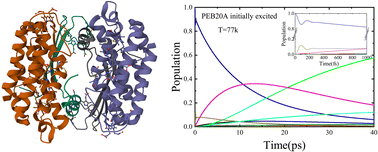
Photosynthesis initiates at the light harvesting stage, where specific pigment–protein complexes can convert absorbed light energy into electronic excited states. These excited states are transferred to the reaction center, initiating charge separation. Existing studies have confirmed that quantum coherence between electronic excited states plays a pivotal role in excitation energy transfer. In this paper, we employ the dissipation equation of motion (DEOM) method from quantum dissipation theory to investigate the influence of the structure of the PE555 complex on its exciton dynamics, while also exploring the quantum coherence characteristics during the excitation energy transfer process of the complex. The research focuses on examining the effects of exciton-type Hamiltonians obtained by two different methods (the point dipole approximation (PDA) method and the transition charge from electrostatic potential (TrEsp) method) on the aforementioned processes. The results demonstrate that, under both low temperature and room temperature conditions, when the Hamiltonian obtained by the PDA method is combined with the DEOM method for calculations, the excitation energy transfer in the PE555 complex is faster, and more energy is transferred to the DBV50/61B molecule. The analysis reveals that the open structure of the PE555 complex results in larger exciton coupling values obtained by the PDA method, with a wider coupling distribution compared to that from the TrEsp method, which directly facilitates the efficient transfer of excitation energy. This study provides a theoretical basis for understanding the regulatory mechanisms of quantum coherence effects and structural characteristics on energy transfer in light harvesting systems.
 Please wait while we load your content...


