


 PLATFORM UPDATE:


Li2CaP2O7 pyrophosphate ceramics with dual functionality: high-performance NTC thermistor behavior and giant dielectric permittivity
 *ab
*ab
Abstract
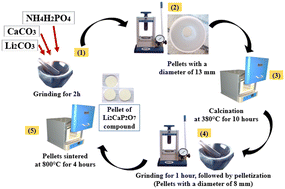
Inorganic pyrophosphate-based materials are widely recognized for their diverse functional properties, positioning them as strong contenders for a range of advanced technological applications. In this work, the compound Li2CaP2O7 was synthesized and examined using a cost-efficient solid-state reaction route. Comprehensive structural and microstructural investigations were carried out to confirm phase purity and assess morphological features. Electrical studies performed between 373 and 673 K revealed semiconducting behavior governed by thermally activated hopping, characterized by a thermistor constant β = 5554 K, an activation energy Ea = 0.49 eV (±0.01), and high temperature sensitivity (−4.0 to −1%/K−1), together with an excellent stability factor (SF = 3.02), underscoring its suitability for high-temperature sensing applications. Analysis of the Nyquist plots using an appropriate equivalent-circuit model allowed the separation of grain and grain-boundary effects. Notably, Li2CaP2O7 exhibited an extremely large dielectric permittivity, on the order of 107 at low frequencies, along with low dielectric losses at higher frequencies. These features point to strong interfacial polarization consistent with the Maxwell–Wagner framework, and the material displays thermally activated, non-Debye-type relaxation dynamics. The interplay between charge transport and polarization mechanisms gives rise to the remarkable coexistence of NTC behavior and giant dielectric response. Altogether, these attributes establish Li2CaP2O7 as a highly promising multifunctional material for integrated high-temperature sensing–capacitor devices and other advanced electronic systems.
 Please wait while we load your content...


