Issue 21, 2026, Issue in Progress

Benzimidazole motifs in drug discovery: sustainable synthetic strategies and emerging biological applications

Abstract

Benzimidazole compounds have laid a strong foundation both in the domains of synthetic organic chemistry and in biological advances. The green synthesis of these materials, which favour sustainability with respect to nature is highly important. Photocatalysis, microwave-assisted and ultrasound-assisted synthesis of benzimidazoles have numerous advantages over conventional methods of synthesis. Various modes of synthesis and catalysis have been developed to take benzimidazole chemistry to different levels, producing attractive compounds in high yields and lowering the formation of impurities. Apart from their synthetic protocols, benzimidazoles have shown great performance in their biological actions in antimicrobial, anticancer, anti-inflammatory and antimycobacterial evaluations. Therefore, we here discuss recent progress in the green synthetic methods of benzimidazoles with their advances in producing biologically active compounds – possibly future potential drug candidates!
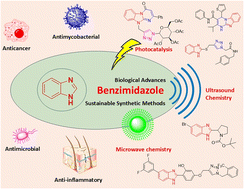
Graphical abstract: Benzimidazole motifs in drug discovery: sustainable synthetic strategies and emerging biological applications

Transparent peer review

To support increased transparency, we offer authors the option to publish the peer review history alongside their article.

View this article’s peer review history

Article information

Article type
Review Article
Submitted
31 Jan 2026
Accepted
25 Mar 2026
First published
13 Apr 2026
This article is Open Access
Creative Commons BY-NC license

RSC Adv., 2026,16, 19470-19498

Benzimidazole motifs in drug discovery: sustainable synthetic strategies and emerging biological applications

G. J. Martis and S. L. Gaonkar, RSC Adv., 2026, 16, 19470 DOI: 10.1039/D6RA00850J

This article is licensed under a Creative Commons Attribution-NonCommercial 3.0 Unported Licence. You can use material from this article in other publications, without requesting further permission from the RSC, provided that the correct acknowledgement is given and it is not used for commercial purposes.

To request permission to reproduce material from this article in a commercial publication, please go to the Copyright Clearance Center request page.

If you are an author contributing to an RSC publication, you do not need to request permission provided correct acknowledgement is given.

If you are the author of this article, you do not need to request permission to reproduce figures and diagrams provided correct acknowledgement is given. If you want to reproduce the whole article in a third-party commercial publication (excluding your thesis/dissertation for which permission is not required) please go to the Copyright Clearance Center request page.

Read more about how to correctly acknowledge RSC content.

Social activity

Spotlight

Advertisements