


 PLATFORM UPDATE:

Molecular dynamics insights into combustion mechanisms of JP-10/aluminum nanoparticle composite fuels
 a
Jianren
Fan
*a
a
Jianren
Fan
*a
Abstract
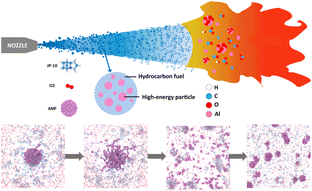
The incorporation of metal nanoparticles can enhance the energy release and ignition performance of high-energy-density fuels; however, the effects of particle aggregation and sedimentation mechanisms on combustion remain insufficiently understood. In this work, reactive molecular dynamics simulations are employed to investigate the ignition and combustion behaviors of JP-10/Al composite systems. A validated JP-10/Al model is constructed, and ignition delay, reaction kinetics, and structural descriptors are analyzed across a temperature range of 2000–3000 K and Al concentrations of 10–40 wt%. The results reveal that Al nanoparticle morphology evolves from chain-like extensions to fragmentation and eventual secondary aggregation. The presence of Al accelerates reactant consumption, shortens ignition delay, and promotes rapid Al–O and Al–C bond formation, which destabilizes JP-10 and facilitates cage ring-opening. The accelerated generation of reactive fragments reduces the apparent activation energy by 49.8%. Increasing Al concentration further emphasizes the trade-off: while low-to-moderate loadings enhance ignition, excessive additions induce severe aggregation and reduce efficiency. An optimal concentration window of 20–25 wt% is identified, balancing ignition promotion with minimal aggregation losses. These findings provide mechanistic insights into the multiscale combustion processes of JP-10/Al systems and offer guidance for the design of high-performance composite fuels in aerospace propulsion.
 Please wait while we load your content...


