


 PLATFORM UPDATE:

Biochar beads as emerging adsorbents for water purification: mechanisms, performance, and applications
 c
and
Jagpreet
Singh
*b
c
and
Jagpreet
Singh
*b
Abstract
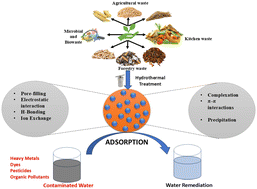
The continuously growing interest in sustainable and innovative materials has driven the production of biochar-based bead adsorbents as recoverable and structurally stable alternatives to powdered biochar. Owing to their tunable physicochemical properties, enhanced mechanical stability, and cost-effectiveness, these materials have emerged as promising material for wastewater treatment applications. This review systematically evaluates recent advancements in the synthesis approaches, surface functionalization, and applications of biochar-based beads in wastewater treatment. The primary focus of the present work is to elucidate the adsorption mechanisms, including electrostatic interactions, surface complexation, π–π electron overlap, hydrogen bonding, ligand exchange, and redox processes that govern the adsorbent performance, with a focus on the oxygen-containing functional groups, polymer-derived functional groups, and aromatic domains in bead matrices that influence these mechanisms. The effects of key experimental parameters such as pH, adsorbent dosage, temperature, contact time, and initial pollutant concentration on adsorption efficiency are critically analyzed. In contrast to other review articles that broadly focus on biochar and its applications in wastewater treatment, the present review specifically focuses on biochar-based bead adsorbents, offering in-depth insights into their synthesis–structure–property relationships, adsorption behaviour, and regeneration potential. Furthermore, the review highlights current limitations and outlines future research directions aimed at enhancing selectivity, stability, scalability, and environmental sustainability.
 Please wait while we load your content...


