


 PLATFORM UPDATE:


Pyrolysis behavior of Sterculia guttata shell biomass: kinetics, thermodynamics, techno-economic and life cycle assessment of industrial-scale biochar production

Abstract
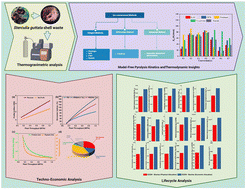
To address the growing demand for renewable energy sources in developing economies, this study evaluates the pyrolysis behavior, kinetics, and thermodynamic characteristics of Sterculia guttata shell waste (SGSW) to determine its suitability as a bioenergy feedstock. Kinetic parameters were calculated using model-free isoconversional techniques. The average activation energies (Ea) acquired varied between 50.21–71.86 kJ mol−1, suggesting moderate energy needs for pyrolysis. Reflecting the complicated response mechanism, the pre-exponential factor (A) varied from 106 to 107 min−1. Thermodynamic study produced enthalpy changes (ΔH) between 22.9 and 54.8 kJ mol−1 and Gibbs free energy (ΔG) values of 152.1 to 156.8 kJ mol−1, demonstrating the endothermic and feasible nature of the process. The study further establishes industrial viability through a techno-economic analysis, which projects a Return on Investment (ROI) of 38.69%, a payback period of 2.7 years, and a Net Present Value (NPV) of USD 6.67 million. The life cycle assessment results underscore that SGSW biochar sustainability is sensitive to allocation methods, with GWP values ranging from 0.88 to 1.27 kg CO2 eq per kg of biochar. These findings underscore the scientific value of SGSW by validating it as a low-energy, economically robust candidate for scalable thermochemical conversion and sustainable bioenergy production.
 Please wait while we load your content...


