


 PLATFORM UPDATE:


Interfaced FeS/g-C3N4 hybrid material for charge transport in supercapacitors
 a
Mohammed M.
Fadhali
i
and
a
Mohammed M.
Fadhali
i
and
Abstract
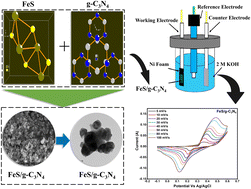
Transition metal sulfides offer multiple favorable properties as electrode materials in supercapacitors owing to their diverse redox chemistry, high theoretical capacitance, and different topologies. They exhibit better electrochemical properties when paired with carbon materials. The effective fabrication of a FeS/g-C3N4 nanocomposite, in which the FeS nanoparticles are evenly adhered to a conductive g-C3N4 framework, was accomplished in this study. The hybrid system improves charge transfer and structural stability by combining the pseudocapacitive properties of FeS with the large area, layered structure, and conductivity of g-C3N4. The g-C3N4 matrix has a high capacity to inhibit the agglomeration of FeS nanoparticles, boost the exposure of electroactive groups, and facilitate rapid ion/electron movements. Consequently, the FeS/g-C3N4 electrode outperforms the immaculate FeS with a high specific capacitance (Csp) of 802.5 F g−1 at 1 A g−1 and 475 F g−1 at 5 A g−1. Further long-term cycling studies reveal the outstanding stability of the electrode with 72.34% capacitance retention despite 5000 cycles. Besides, the composite exhibits exceptional energy and power densities, with an efficient energy density (ED) of 17.83 Wh kg−1 at a power density (PD) of 200 W kg−1 and 10.56 Wh kg−1 at 1.0 kW kg−1. This excellent electrochemical performance is owing to the synergistic effect of FeS and g-C3N4, which increases redox activity, enhances charge transfer and minimizes internal resistance. Our findings show that FeS/g-C3N4 might serve as a feasible option for long-term, high-performance supercapacitor electrodes in next-generation energy storage applications.
 Please wait while we load your content...


