


 PLATFORM UPDATE:


Context-dependent cytotoxicity and ADMET profiling of methoxylated flavonoids as novel leads for metastatic prostate cancer
 *a
*a
Abstract
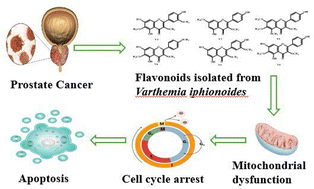
Prostate cancer continues to be a leading cause of cancer-related mortality among men. Acquired resistance to currently available treatment options necessitates discovery of novel bioactive scaffolds. Flavonoids, a group of plant-derived polyphenolic compounds, have been shown to interfere with cellular mechanisms such as mitochondrial functioning, cell-cycle progression and apoptotic cell death. The current study assessed the cytotoxic activity, cellular uptake and apoptosis-inducing properties of six structurally diverse methoxylated flavonoids isolated from Varthemia iphionoides, namely jaceidin (V1), kumatakenin (V2), 4′-hydroxy-3,5,6,7-tetramethoxyflavone (V3), santin (V4), quercetin-3,3′-dimethyl ether (V5) and 6-methoxyisokaempferide (V6) in metastatic prostate cancer cell lines PC3 and DU145. The cytotoxic activity of these compounds was assessed using MTT assay and the apoptosis, mitochondrial membrane potential and cell-cycle phases were analyzed employing flow cytometry-based assays. Flavonoids V3, V5 and V6 demonstrated the most promising cytotoxic activities among the series. Compound V3 exhibited IC50 values of 7.22 ± 0.21 µM and 1.30 ± 0.69 µM, V5 of 5.16 ± 0.13 µM and 28.17 ± 2.74 µM, while V6 showed 1.67 ± 0.87 µM and 1.90 ± 0.88 µM in PC3 and DU145 cell lines respectively. Flavonoid V3 mediated perturbation of cell-cycle dynamics was cell line specific via G2/M phase arrest in PC3 cells (45.2 ± 2.0% at 48 h along with significant sub-G1 population i.e. 8.9 ± 0.7%) and S-phase accumulation in DU145 cells (40.1 ± 1.9% at 48 h with sub-G1 population of 6.3 ± 0.5%). A moderate rate of apoptosis and significant MMP depolarization was observed, indicating the role of mitochondria-associated cell death pathways. The in silico ADMET profile of the compounds revealed good drug-likeness properties hence pointing to the lead like nature of these compounds. The overall data signify the potential of methoxylated flavonoids as modulators of mitochondrial functioning and cell-cycle dynamics in metastatic prostate cancer.
 Please wait while we load your content...


