Issue 15, 2026, Issue in Progress

Two-dimensional Ruddlesden–Popper perovskite microcrystal photodetectors with high detectivity for ultra-weak light detection

Abstract

Strong light absorption capabilities, excellent semiconductor properties, and enhanced humidity and light stability have led to the rapid development of two-dimensional (2D) organic–inorganic metal halide perovskites in the field of light detection. However, so far, the research on weak light detection of 2D perovskite is insufficient, and its detection limit needs to be further broken. Here, high-quality (C6H5CH2CH2NH3, PEA)2PbBr4 perovskite single crystals with low defect density are prepared. Lateral photodetectors based on this perovskite single crystal demonstrate stable photoresponse under ultra-weak ultraviolet illumination. The very low dark current of 4.75 × 10⁻¹¹ A provides a low-noise baseline that is essential for achieving high detectivity under weak light conditions. Even at an optical power density as low as 2.47 nW cm−2, the device exhibits a responsivity of 19.23 A W−1. The corresponding gain and specific detectivity reach 58.80 and 1.22 × 10¹⁴ Jones, respectively. These results confirm the suitability of 2D perovskite single crystals for ultra-weak light photodetection.
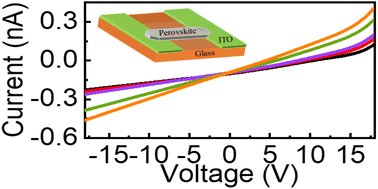
Graphical abstract: Two-dimensional Ruddlesden–Popper perovskite microcrystal photodetectors with high detectivity for ultra-weak light detection

Supplementary files

Article information

Article type
Paper
Submitted
27 Nov 2025
Accepted
13 Feb 2026
First published
11 Mar 2026
This article is Open Access
Creative Commons BY-NC license

RSC Adv., 2026,16, 13243-13251

Two-dimensional Ruddlesden–Popper perovskite microcrystal photodetectors with high detectivity for ultra-weak light detection

Y. Wang, Y. Ma, J. Liu and S. Li, RSC Adv., 2026, 16, 13243 DOI: 10.1039/D5RA09159D

This article is licensed under a Creative Commons Attribution-NonCommercial 3.0 Unported Licence. You can use material from this article in other publications, without requesting further permission from the RSC, provided that the correct acknowledgement is given and it is not used for commercial purposes.

To request permission to reproduce material from this article in a commercial publication, please go to the Copyright Clearance Center request page.

If you are an author contributing to an RSC publication, you do not need to request permission provided correct acknowledgement is given.

If you are the author of this article, you do not need to request permission to reproduce figures and diagrams provided correct acknowledgement is given. If you want to reproduce the whole article in a third-party commercial publication (excluding your thesis/dissertation for which permission is not required) please go to the Copyright Clearance Center request page.

Read more about how to correctly acknowledge RSC content.

Social activity

Spotlight

Advertisements