


 PLATFORM UPDATE:


Pyrazole/pyrimidine derivatives endowed with azobenzenes as dual EGFRT790M and VEGFR-2 inhibitors: anticancer, docking, synthesis, design and ADMET assessments
 a
Nour E. A.
Abd El-Sattar,
ad
Tamer
Nasr,
gh
Khaled
El-Adl
*jk
and
Naglaa M.
Ahmed
l
a
Nour E. A.
Abd El-Sattar,
ad
Tamer
Nasr,
gh
Khaled
El-Adl
*jk
and
Naglaa M.
Ahmed
l
Abstract
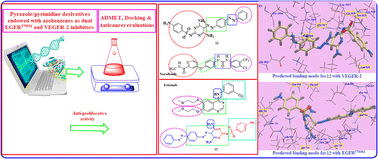
New pyrazole/pyrimidine derivatives endowed with azobenzenes were synthesized using microwave and traditional methods. Our compounds were assessed for cytotoxicity against HepG2, MCF-7, HCT-116 and A549 cell lines as dual inhibitors of EGFRT790M and VEGFR-2. A docking study was carried out to show the binding affinities and orientations of our derivatives in the active sites of VEGFR-2 and EGFRT790M. The data of the docking study were highly correlated with the biological data. The HCT116 and A549 cell lines were extremely affected by our derivatives. Derivative 12 showed the greatest activity against A549, HepG2, MCF-7 and HCT116 cells, with IC50 = 5.12, 6.77, 5.85 and 5.25 µM, respectively. It showed higher cytotoxicity than erlotinib (IC50 = 5.49, 7.73, 8.20 and 13.91 µM, respectively) and lower cytotoxicity than sorafenib (IC50 = 4.04, 4.00, 5.58 and 5.05 µM, respectively) against the tested cell lines. The cytotoxicity of the highly active derivatives 5, 6, 8, 9, 10 and 12 against the MCF-10 healthy cell lines was evaluated. The assessed derivatives showed low cytotoxicity against MCF-10 cells, with IC50 = 50.90–55.50 µM. Additionally, all derivatives were assessed as dual VEGFR-2 and EGFRT790M inhibitors. Compounds 12, 8 and 10 displayed very good inhibitions toward VEGFR-2, with IC50 = 0.90, 0.95 and 1.00 µM, respectively. Similarly, structures 12, 8, 10, 5 and 9 showed strong EGFRT790M inhibitions, with IC50 = 0.25, 0.30, 0.33, 0.35 and 0.40 µM, respectively. In addition, in silico ADMET predictions were calculated for the highly active derivatives 8, 10 and 12 and correlated to Lipinski's rule of five using erlotinib and sorafenib as standard ligands. The results presented our derivatives as promising candidates for advanced manipulations to get more potent anticancer agents with advanced VEGFR-2 and EGFRT790M inhibitions.
 Please wait while we load your content...


