


 PLATFORM UPDATE:


Enhanced sensing characteristics of N doped and (N, O) co-doped molybdenum disulfide to detect toxic gases: a comprehensive first-principles study
 g
Duy Khanh
Nguyen
*hi
g
Duy Khanh
Nguyen
*hi
Abstract
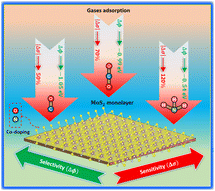
First-principles calculations based on density functional theory were conducted to investigate the adsorption of CO, CO2, and NH3 molecules on pristine, N doped, and (N, O) co-doped MoS2 surfaces. Pristine MoS2 systems exhibit weak physisorption with long adsorption distances, insignificant adsorption energies, and negligible charge transfer, resulting in poor gas selectivity and low electronic sensitivity toward all gases. N doping slightly enhances adsorption strength and charge exchange through defect-induced electronic modulation, improving the interaction with NH3 but showing limited response to CO and CO2. In contrast, (N, O) co-doping substantially reinforces molecule–substrate interactions by reducing adsorption distances and increasing charge redistribution across the surface. The (N, O) co-doped MoS2 system exhibits pronounced work-function shifts of −1.07, −0.99, and −0.54 eV for CO, CO2, and NH3, respectively, together with strong energy-resolved conductivity variations, with average conductivity changes of about 30–40% for CO, 35–50% (peaks ≈70%) for CO2, and 45–60% with maximum peaks exceeding 120% for NH3. Compared with previous studies focusing on either N- or O-doped MoS2, our work provides a systematic, side-by-side comparison of pristine, N-doped, and (N, O) co-doped systems and identifies (N, O) co-doping as a more effective route to simultaneously enhance sensitivity and selectivity toward CO and CO2.
 Please wait while we load your content...


