


 PLATFORM UPDATE:


Ternary transition metal Co-Fe-Ni sulfide as a high-performance anode in microbial fuel cells

Abstract
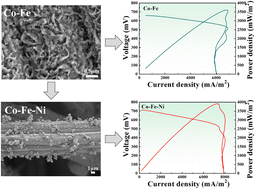
The development of high-performance anode materials remains a critical challenge in advancing microbial fuel cells (MFCs). In this work, we present a novel strategy employing ternary transition metal Co-Fe-Ni sulfides to overcome the inherent trade-off between catalytic activity and structural stability commonly observed in conventional polymetallic sulfides. Through a facile one-pot solvothermal approach, we synthesized low-crystallinity CoFeNiSx (Co-Fe-Ni) ternary sulfides with precisely tunable Co/Fe/Ni molar ratios. When integrated as an MFC anode, the optimized Co-Fe-Ni sulfide delivered a maximum power density of 3915 mW m−2 using Escherichia coli (E. coli) as the biocatalyst, representing an 8.4% enhancement over its binary CoFeSx (Co-Fe) analogue. This performance exceeds that of most previously reported carbon-based anodes. The synthesized transition metal sulfides combine ease of fabrication with outstanding electrocatalytic efficiency. Our findings highlight the underexplored potential of ternary transition metal sulfides in engineering next-generation bioelectrochemical interfaces.
 Please wait while we load your content...


