


 PLATFORM UPDATE:


Detection of polyphenols-to-amino acids ratio in Wuyi Rock Tea via CARS-PLSR processing of near infrared spectroscopy
 *a
*a
Abstract
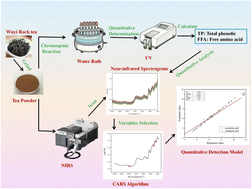
The total polyphenols (TP), free amino acids (FAA), and the polyphenols-to-amino acids ratio (TP/FAA) serve as crucial indicators of the taste quality of tea. Traditional detection methods, however, often suffer from limitations such as prolonged analysis time, complex procedures, and the potential for reagent contamination. To expedite the determination and analysis of the TP/FAA in Wuyi Rock Tea, this study employed three wavelength selection methods: Uninformative Variable Elimination (UVE), Successive Projections Algorithm (SPA), and Competitive Adaptive Reweighted Sampling (CARS). These approaches were integrated with Partial Least Squares Regression (PLSR) and Principal Component Regression (PCR) to develop a quantitative analysis model for the polyphenols-to-amino acids ratio in Wuyi Rock Tea. Results revealed that after applying Standard Normal Variate (SNV) combined with Savitzky–Golay Derivative (SD) preprocessing to the near-infrared (NIR) spectra, all three methods improved model performance to varying extents, with the CARS-PLSR wavelength selection method demonstrating the most significant optimization. The coefficients of determination for both calibration and prediction sets of the TP/FAA ratio reached 0.9897 and 0.9812, respectively, while the root mean square error of calibration (RMSEC) and prediction (RMSEP) were 0.1854 and 0.1434, respectively. The relative percent deviation (RPD) was 3.21, indicating enhanced stability and accuracy of the quantitative model. Validation results confirmed that the CARS-PLSR method effectively extracted essential NIR spectral variables while concurrently eliminating redundant spectral noise. This study presents a novel framework for rapid tea quality assessment using NIR spectroscopy.
 Please wait while we load your content...


