


 PLATFORM UPDATE:


Synthesis and microstructural properties of Pt-decorated α-Fe2O3 nanotubes for hydrogen gas sensing applications

Abstract
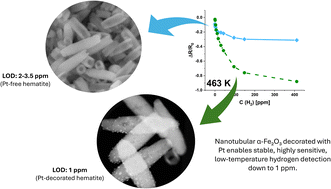
Pt-free and Pt-decorated α-Fe2O3 nanotubes containing 1 and 5 mol% Pt were hydrothermally synthesized to investigate how Pt decoration influences low-temperature hydrogen sensing beyond simple catalytic enhancement. Unlike many previous studies that focus primarily on sensing performance, this work correlates Pt-induced microstructural and magnetic ordering with sensor behavior. Structural characterization confirmed retention of the hematite phase after Pt modification, while XPS revealed both metallic and oxidized Pt species, along with an increased concentration of surface oxygen species. Mössbauer spectroscopy, EPR, and magnetic measurements showed that Pt decoration, assisted by heat treatment, partially restores the Morin transition and improves magnetic ordering, which directly correlates with the observed enhancement in sensing performance. Compared to Pt-free hematite, Pt-decorated nanotubes exhibited significantly improved hydrogen detection, achieving a detection limit of 1.0 ppm at 463 K with a fast response of 3.6 s. Notably, efficient sensing was achieved at lower operating temperatures (down to 363 K), with only 1 mol% Pt required to obtain high sensitivity and rapid response. Measurements performed in nitrogen further revealed enhanced responses due to reduced oxygen competition and promoted hydrogen spillover on Pt sites. These results demonstrate that Pt decoration of reducible α-Fe2O3 nanotubes links structural and magnetic ordering with hydrogen sensing performance, providing guidance for the rational design of advanced hydrogen sensors.
 Please wait while we load your content...


