


 PLATFORM UPDATE:


Surface reinforcement of rice straw fibers for epoxy composites by ultrasonic, plasma, and sodium carbonate-assisted hybrid treatments

Abstract
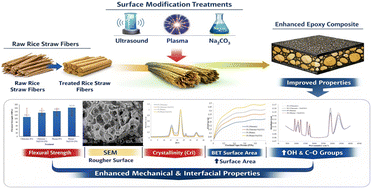
Rice straw represents a plentiful agricultural by-product that remains largely underexploited, particularly for composite reinforcement, due to poor fiber-matrix interactions and its high amorphous fraction. In this study, environmentally benign surface modification strategies were explored to ensure better mutual performance of rice-straw grains with an epoxy pattern. Four activation approaches were evaluated: ultrasonic treatment (P1), ultrasonic assisted with sodium carbonate (P2), plasma exposure (P3), and a combined Na2CO3-plasma sequence (P4). Fibers were processed using 5% w/v Na2CO3 solution and low-pressure plasma at 13.56 MHz, followed by fabrication of epoxy composites. The materials were examined through several analytical methods, including flexural evaluation (ASTM D790), FTIR spectroscopy, SEM-EDX imaging, XRD diffraction, TGA/dTG thermal analysis, and BET surface analysis. An overall enhancement in mechanical characteristics was detected as the degree of treatment increased. Sample P1 had a flexural durability of approximately 109.1 MPa, while sample P4 showed elasticity at 162.0 MPA and the range of modalities in terms of their articulation was expanded by 5.625 GPa (passive modulus) from 3.709 GPa when tested against other methods. SEM micrographs revealed remarkable surface alterations, such as a 131% rise in micro-texture roughness (from 0.344 to 0.796), resin deposition reaching 90.8%, a 72% decline in pore or void fraction (from 3.319% to 0.917%), and an 84% reduction in silica or ash residues. XRD profiles showed more pronounced cellulose-I reflections at 15.7°, 22.6°, and 34.6°, alongside the suppression of the amorphous halo (18–20°), signifying increased crystallinity, particularly in P4 fibers. TGA results demonstrated reduced char residue and higher, sharper Tmax peaks, confirming improved thermal stability. Among the treatments, the Na2CO3-assisted plasma approach (P4) provided the most substantial enhancement, offering a scalable and sustainable method to upgrade rice-straw fibers for structural composite applications.
 Please wait while we load your content...


