


 PLATFORM UPDATE:


Thermally stable network-structured polysiloxane hybrimers with high refractive index for optical applications
 a
and
Honglae
Sohn
*a
a
and
Honglae
Sohn
*a
Abstract
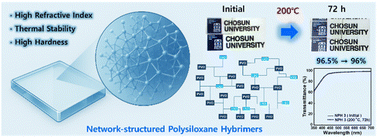
In this study, network-structured polysiloxane hybrimers (NPH 1–3) were synthesized for high-performance optical encapsulation, focusing on advanced LED applications. Among them, NPH 3 exhibited exceptional optical and mechanical properties. At wavelengths of 450, 520, and 635 nm, it demonstrated a high refractive index of 1.61, 1.59, and 1.58, respectively, and an outstanding transmittance of 96.5% at 450 nm. The material exhibited rapid curing within 4.5 hours and a high hardness of 76.2 Shore D, surpassing conventional encapsulants like epoxy resins and commercial silicone polymers. Notably, NPH 3 maintained excellent thermal stability, as thermal aging at 200 °C for 72 h resulted in only a marginal decrease in transmittance from 96.5% to 96%, which demonstrates its remarkable resistance to optical degradation under prolonged high temperature exposure. This high thermal resilience, together with its superior refractive properties, boosts light extraction efficiency by minimizing internal reflections, rendering the material exceptionally attractive for various optoelectronic applications. Beyond traditional LED encapsulation, the impressive thermal stability expands its applicability to systems operating at elevated temperatures, such as high power LED systems, high resolution sensors, photonic devices, aerospace and automotive electronics, and high-temperature industrial sensors. NPH 3 exhibits a well balanced set of properties, including high optical transparency, rapid curing kinetics, and enhanced mechanical strength, attributed to its network-structured phenylsiloxane framework. These characteristics collectively identify NPH 3 as a promising candidate for next-generation encapsulant materials in advanced optoelectronic systems where long-term reliability and high operational efficiency are essential.
 Please wait while we load your content...


