


 PLATFORM UPDATE:

Synthesis and binding studies of two new coumarin-squaramide-based receptors for NSAIDs
 c
Patrizia
Rossi,
d
Mauro
Formica,
a
Eleonora
Macedi,
a
Luca
Giorgi,
*a
Luca
Prodi,
*b
Vieri
Fusi
*a
and
Daniele
Paderni
a
c
Patrizia
Rossi,
d
Mauro
Formica,
a
Eleonora
Macedi,
a
Luca
Giorgi,
*a
Luca
Prodi,
*b
Vieri
Fusi
*a
and
Daniele
Paderni
a
Abstract
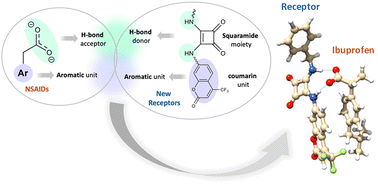
Two new squaramide-based receptors containing coumarin units have been synthesized and characterized in both solution and solid states. L1 (3-(benzylamino)-4-((2-oxo-4-(trifluoromethyl)-2H-chromen-7-yl)amino)cyclobut-3-ene-1,2-dione) is a linear molecule, while L2 (4,4′-((1,3-phenylenebis(methylene))bis(azanediyl))bis(3-((2-oxo-4-(trifluoromethyl)-2H-chromen-7-yl)amino)cyclobut-3-ene-1,2-dione)) is an open chain ligand which results in the ditopic form of the simpler parent ligand L1. The new molecules have been designed to act as receptors for non-steroidal anti-inflammatory drugs (NSAIDs) possessing both squaramide units as double hydrogen bond (HB) donor sites that are able to interact with the carboxylate functions of the guests, and 4-trifluoromethylcoumarin moieties as aromatic photoactive domains to facilitate π-stacking or hydrophobic interactions with the drug's aromatic rings. The ability of the new receptors to interact with benzoate (BzO−), ibuprofen (IBU−), naproxen (NPX−) and ketoprofen (KET−) sodium salts was studied via UV-Vis and fluorescence spectroscopy, 1H-NMR measurements and DFT calculations. Finally, mass spectrometry studies demonstrated that L1 showed the tendency to form adducts with a 2 : 1 ligand-to-anion stoichiometry ([L12-Anion]−), while only adducts with a 1 : 1 stoichiometry ([L2-Anion]−) were visible for L2.
 Please wait while we load your content...


