


 PLATFORM UPDATE:

Energy from trash: a flexible, facile, and robust triboelectric nanogenerator based on waste polystyrene and application as a human–machine interface
 *a
*a
Abstract
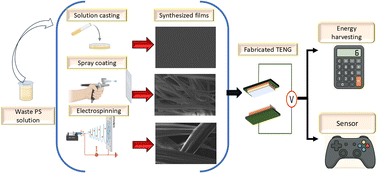
The accelerated urbanization and rapid growth of the global population has resulted in the generation of massive amounts of municipal solid waste, mainly containing plastics. The improper disposal and minimal recycling rate of these waste materials exacerbate several environmental challenges. The present study focuses on the recycling of waste polystyrene (PS) by fabricating triboelectric nanogenerators (TENGs) based on PS films synthesized by various methods, i.e., solution casting, electrospinning, and spray coating as a positive triboelectric material. Fourier-Transform Infrared (FTIR) spectroscopy and Field-Effect Scanning Electron Microscopy (FE-SEM) were used to analyze the functional groups and morphology of the synthesized films. The spray-coated PS-based TENG exhibited the highest electrical performance with a maximum open circuit voltage (Voc) of 690 V at 4 Hz, short-circuit current of (Isc) of 67 µA at 5 Hz, and maximum output power density of 28 W m−2 at 50 MΩ of load resistance. This enhanced performance can be attributed to the nanofibrous nature and increased surface area of the spray-coated films. The practical applications of PS-TENGs were also demonstrated, and include charging various capacitors and powering a calculator using a rectified voltage circuit. Also, the real-time control of a small remote-controlled (RC) car has been successfully demonstrated using PS-based TENGs. This innovative study paves the way for a circular economy by recycling waste plastic material into novel functional materials and accelerates the pathway for energy harvesting and smart sensors.
 Please wait while we load your content...


