


 PLATFORM UPDATE:


Functionalization of carbon nanospheres with curcumin, polyethylene glycol and folic acid: potential use as drug carriers

Abstract
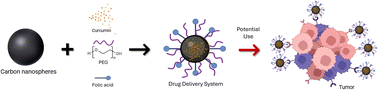
This study reports the synthesis of carbon nanospheres (CNS) modified by anchoring curcumin (CUR), polyethylene glycol (PEG) and folic acid (FA) on their surface as a drug delivery system (DDS) for potential applications in cancer therapy. CNS were synthesized via chemical vapor deposition (CVD) while CUR and PEG were anchored onto their surface by impregnation, and FA conjugation was achieved using N-hydroxysuccinimide (NHS) and 1-ethyl-3-(3-dimethylaminopropyl)carbodiimide (EDC) as coupling agents. The modified CNS underwent comprehensive characterization using scanning electron microscopy (SEM), Fourier-transform infrared (FTIR) spectroscopy, Raman spectroscopy, thermogravimetric analysis (TGA), X-ray diffraction (XRD), zeta potential measurements, and release profile analysis. The functionalization of CNS was successfully achieved, yielding particles with an average size of 150 nm, a polydispersity index (PDI) of 0.215, zeta potential of −27.7 mV and loading efficiency (LE%) of 63.63 ± 1.61%. Release profile experiments demonstrated a sustained pH-responsive drug release of 3.3% at pH 7.4 vs. 4.3% at pH 5.8 after 48 h.
 Please wait while we load your content...


