Issue 6, 2026, Issue in Progress

Self-supported Co3O4@Zn–CoNi2S4/NF core–shell nanoarrays as an efficient bifunctional electrode for overall water splitting

Abstract

It is a crucial matter to develop bifunctional transition metal catalysts for water electrolysis. In this study, we fabricate a Co3O4@Zn–CoNi2S4 core–shell heterostructure supported on nickel foam (Co3O4@Zn–CoNi2S4/NF). The compound structure can generate more active centers and exhibit some unique characteristics. Moreover, the doping of Zn further enhances the catalytic performance. It can optimize the lattice structure of the Co3O4@CoNi2S4/NF heterostructure and reduce the reaction energy barrier effectively, which can meet the relatively strict requirements of high-performance electrocatalysts. This material can be used as an efficient bifunctional electrocatalyst. In 1 M KOH electrolyte, the material shows excellent electrocatalytic performance for OER and HER. It possesses a low overpotential of 190 mV at 10 mA cm−2 for OER and 120 mV at 10 mA cm−2 for HER. Also, it maintains long-term stability. The Co3O4@Zn–CoNi2S4/NF electrolytic cell acts as a two-electrode system for overall water splitting. It needs a battery voltage of 1.45 V to drive the current density to 10 mA cm−2. This research has proved that combining metal doping with heterogeneous interface design is a feasible strategy for developing high-performance bifunctional electrocatalysts.
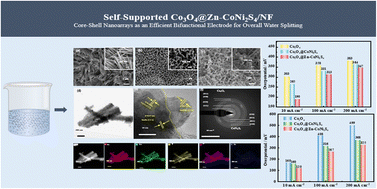
Graphical abstract: Self-supported Co3O4@Zn–CoNi2S4/NF core–shell nanoarrays as an efficient bifunctional electrode for overall water splitting

Supplementary files

Article information

Article type
Paper
Submitted
06 Dec 2025
Accepted
09 Jan 2026
First published
22 Jan 2026
This article is Open Access
Creative Commons BY-NC license

RSC Adv., 2026,16, 4848-4858

Self-supported Co3O4@Zn–CoNi2S4/NF core–shell nanoarrays as an efficient bifunctional electrode for overall water splitting

X. Zhao, Y. Dong, Z. Wang, Y. Qiu, E. Wang, N. Sun and Y. Tong, RSC Adv., 2026, 16, 4848 DOI: 10.1039/D5RA09427E

This article is licensed under a Creative Commons Attribution-NonCommercial 3.0 Unported Licence. You can use material from this article in other publications, without requesting further permission from the RSC, provided that the correct acknowledgement is given and it is not used for commercial purposes.

To request permission to reproduce material from this article in a commercial publication, please go to the Copyright Clearance Center request page.

If you are an author contributing to an RSC publication, you do not need to request permission provided correct acknowledgement is given.

If you are the author of this article, you do not need to request permission to reproduce figures and diagrams provided correct acknowledgement is given. If you want to reproduce the whole article in a third-party commercial publication (excluding your thesis/dissertation for which permission is not required) please go to the Copyright Clearance Center request page.

Read more about how to correctly acknowledge RSC content.

Social activity

Spotlight

Advertisements