


 PLATFORM UPDATE:


Research on the initial corrosion behavior of A100 steel in salt fog-SO2 environment
 a
Jia
Li
b
and
a
Jia
Li
b
and
Abstract
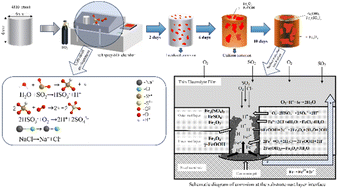
To investigate the service performance of A100 steel with the chemical composition 23Co14Ni12Cr3Mo in actual ship deck environments, this study innovatively adopts the ASTM G85 “salt spray-SO2 modified salt spray test” to simulate the weakly acidic marine atmosphere containing engine exhaust pollutants. This approach addresses the limitation of domestic studies that primarily rely on neutral salt spray tests following GJB150.11A, which fail to reflect complex service conditions. The corrosion behavior, product composition and electrochemical kinetics of A100 steel were systematically characterized using multiple techniques including SEM, XRD, XPS, FT-IR, EDS, electrochemical workstation and EBSD. Results show that the corrosion process exhibits triphasic kinetics: rapid initial corrosion from 2 to 4 days due to direct contact between the metal and corrosive medium, with charge transfer resistance (Rct) decreasing from 2860 Ω cm2 to 1029 Ω cm2 and corrosion current density (Icorr) increasing from 5.09 µA cm−2 to 7.35 µA cm−2; decelerated degradation from 4 to 8 days by the formation of a dual-layer rust structure consisting of a dense inner layer of Fe3O4 and γ-FeOOH as well as a porous outer layer of Fe2O3, with Rct peaking at 5421 Ω cm2 and Icorr dropping to the minimum of 1.73 µA cm−2; and renewed acceleration from 8 to 10 days caused by the synergistic damage of Cl− and HSO3− to the rust layer, with Rct plummeting to 426 Ω cm2 and Icorr surging to 23.44 µA cm−2. Alloying elements including Cr, Co and Ni regulate corrosion resistance by modifying the rust layer structure and electrochemical properties. Microstructurally, the initial passivation of austenite delays corrosion, while the subsequent dissolution of martensite and the establishment of a dynamic phase equilibrium ultimately expose austenite, accelerating degradation beyond 10 days. This work clarifies the corrosion mechanism of A100 steel under salt spray-SO2 coupling, providing a reliable experimental basis and theoretical support for its safe application in marine aviation equipment.
 Please wait while we load your content...


