Issue 6, 2026

Catalytic wet air oxidation of phenol in caustic refinery effluents

Abstract

Phenol, in industrial aqueous effluents, causes serious damage to human health and ecosystems due to its high toxicity. Catalytic wet air oxidation (CWAO) is a process that effectively transforms phenol into compounds with lower environmental impact. The development of catalysts capable of operating continuously without activity loss in industrial effluents is a challenge due to metal leaching deactivation caused by the formation of organic acids during oxidation reactions. In particular, effluents from caustic treatments in refineries extract large amounts of phenol and their treatment by CWAO has not been widely addressed. In the present study, CuO and ZnO catalysts were synthesized by employing different aluminum-based supports, which not only achieved high phenol oxidation in neutral aqueous solutions, but also increased the phenol degradation degree with great stability in a refinery sample from caustic treatment, making CWAO viable for processing industrial effluents.
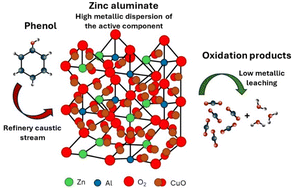
Graphical abstract: Catalytic wet air oxidation of phenol in caustic refinery effluents

Article information

Article type
Paper
Submitted
30 Oct 2025
Accepted
26 Dec 2025
First published
26 Jan 2026
This article is Open Access
Creative Commons BY-NC license

RSC Adv., 2026,16, 5325-5335

Catalytic wet air oxidation of phenol in caustic refinery effluents

J. F. Palomeque-Santiago and J. J. Castro-Arellano, RSC Adv., 2026, 16, 5325 DOI: 10.1039/D5RA08364H

This article is licensed under a Creative Commons Attribution-NonCommercial 3.0 Unported Licence. You can use material from this article in other publications, without requesting further permission from the RSC, provided that the correct acknowledgement is given and it is not used for commercial purposes.

To request permission to reproduce material from this article in a commercial publication, please go to the Copyright Clearance Center request page.

If you are an author contributing to an RSC publication, you do not need to request permission provided correct acknowledgement is given.

If you are the author of this article, you do not need to request permission to reproduce figures and diagrams provided correct acknowledgement is given. If you want to reproduce the whole article in a third-party commercial publication (excluding your thesis/dissertation for which permission is not required) please go to the Copyright Clearance Center request page.

Read more about how to correctly acknowledge RSC content.

Social activity

Spotlight

Advertisements