


 PLATFORM UPDATE:


Emerging trends and structure–activity insights of Schiff base–lanthanide complexes as antibacterial agents
 a
Nitesh
Jaiswal,
b
Urvashi,
c
Amar
Nath,
a
Manoj
Kumar,
d
Divya
Mishra
e
and
Navneet
Yadav
*c
a
Nitesh
Jaiswal,
b
Urvashi,
c
Amar
Nath,
a
Manoj
Kumar,
d
Divya
Mishra
e
and
Navneet
Yadav
*c
Abstract
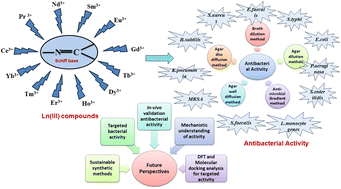
The rapid escalation of microbial resistance has accelerated the search for next-generation antibacterial agents with novel mechanisms of action. Schiff bases and their lanthanide complexes have emerged as promising candidates due to their tunable structures, coordination versatility and enhanced bioactivity upon metal binding. While earlier reviews laid the foundational understanding of antibacterial activity of Schiff bases and their metal complexes, this review advances the field by offering a data-driven, mechanistically informed and structure–activity-focused perspective on the most recent antibacterial findings (2018–2025) of Schiff bases and their Ln(III) complexes. In this review article, we critically compare the antibacterial performance of diverse ligand frameworks with lanthanide ions, under varied experimental conditions against both Gram-negative and Gram-positive bacterial strains highlighting trends in structure–activity correlations. We also identify clear trends: Schiff base ligands alone usually show modest or weak antibacterial activity, which is significantly enhanced upon complexation with lanthanide ions. Additionally, unresolved challenges, including toxicity, bioavailability and resistance modulation are discussed alongside proposed future research pathways. This perspective aims to guide the rational design of Schiff base–lanthanide complexes toward clinical translation as potent antibacterial agents.
- This article is part of the themed collection: 2026 Reviews in RSC Advances
 Please wait while we load your content...


