Issue 8, 2026, Issue in Progress

Synergistic NIR-polydopamine nanotherapy for blood–brain barrier crossing and Parkinson's disease intervention

Abstract

Despite its clinical success, conventional deep-brain stimulation (DBS) for Parkinson's remains limited by its invasive nature. To overcome this, we engineered ZnO@polydopamine (ZnO@PDA) nanocomposites as a non-invasive neurotherapeutic platform. By leveraging rational nanostructure design, ZnO@PDA enabled reversible blood–brain barrier (BBB) opening via a photothermal mechanism, thereby permitting targeted nanoparticle delivery. Upon reaching the brain, nanocomposites harness ultrasound-driven electrical stimulation to precisely modulate neuronal circuits, thus offering a groundbreaking alternative to traditional DBS. Simultaneously, their potent antioxidant activity neutralizes reactive oxygen species, suppresses microglial overactivation, and mitigates pathological α-synuclein aggregation. In vivo studies demonstrated that laser-triggered ZnO@PDA treatment significantly restored dopaminergic neuronal function and improved motor coordination, whereas ultrasound-based protocols alone were less effective owing to insufficient BBB penetration. Our work presents a “penetration–accumulation–stimulation” cascade strategy, delivering a transformative approach to non-invasive treatment of neurodegenerative disorders.
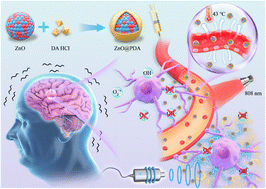
Graphical abstract: Synergistic NIR-polydopamine nanotherapy for blood–brain barrier crossing and Parkinson's disease intervention

Supplementary files

Article information

Article type
Paper
Submitted
09 Oct 2025
Accepted
28 Jan 2026
First published
04 Feb 2026
This article is Open Access
Creative Commons BY-NC license

RSC Adv., 2026,16, 6985-6998

Synergistic NIR-polydopamine nanotherapy for blood–brain barrier crossing and Parkinson's disease intervention

X. Xia, J. Han, M. Lin, Y. Tu, Y. Zheng, B. Liu, Y. Chen, X. Li, Z. Zhang, S. Han, W. Shang, X. Huang and J. Liu, RSC Adv., 2026, 16, 6985 DOI: 10.1039/D5RA07719B

This article is licensed under a Creative Commons Attribution-NonCommercial 3.0 Unported Licence. You can use material from this article in other publications, without requesting further permission from the RSC, provided that the correct acknowledgement is given and it is not used for commercial purposes.

To request permission to reproduce material from this article in a commercial publication, please go to the Copyright Clearance Center request page.

If you are an author contributing to an RSC publication, you do not need to request permission provided correct acknowledgement is given.

If you are the author of this article, you do not need to request permission to reproduce figures and diagrams provided correct acknowledgement is given. If you want to reproduce the whole article in a third-party commercial publication (excluding your thesis/dissertation for which permission is not required) please go to the Copyright Clearance Center request page.

Read more about how to correctly acknowledge RSC content.

Social activity

Spotlight

Advertisements