


 PLATFORM UPDATE:


Green synthesis of polypyrrole-SnO2 nanocomposites using Foeniculum vulgare extract for crystal violet adsorption and solvent-dependent radical scavenging
 *a
Annu
Pandey
*b
*a
Annu
Pandey
*b
Abstract
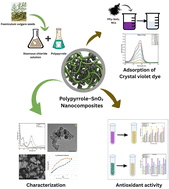
The development of multifunctional nanomaterials provides new opportunities to address both environmental and biomedical challenges. In this study, SnO2 nanoparticles were synthesized using Foeniculum vulgare seed extract and subsequently incorporated into independently synthesized polypyrrole (APS-mediated oxidative polymerization) to obtain PPy-SnO2 nanocomposites. Comprehensive structural, optical and morphological analyses, including FTIR, UV-Vis spectrophotometry, XRD, SEM-EDS, HRTEM, DLS, zeta potential, and BET, confirmed the successful formation of the nanocomposites and the uniform incorporation of SnO2 within the PPy matrix. The PPy-SnO2 nanocomposites demonstrated significant adsorption performance for crystal violet, achieving 92% removal under optimized conditions, including pH 7, a dye concentration of 10 ppm, 50 mg adsorbent, and 50 °C for 150 min. Adsorption behaviour followed a pseudo-2nd-order kinetic model, and a maximum capacity of 162.6 mg g−1 estimated from the Langmuir isotherm was achieved. The antioxidant activity assessed by DPPH and ABTS assays in methanol and hexane showed higher radical scavenging efficiency in methanol, achieving 90.8% inhibition at 800 µg mL−1. PPy-SnO2 consistently outperformed pure polypyrrole, indicating the significant role of SnO2 in enhancing electron-transfer-based scavenging. Overall, these results highlight the PPy-SnO2 NCs as an effective dual-application material that combine strong antioxidant properties with high-efficiency dye removal to provide a sustainable approach for environmental remediation.
 Please wait while we load your content...


