


 PLATFORM UPDATE:


Synthesis of carbazoles via aryl C–H activation triggered by surfactant-associated palladium nanoparticles under microwave-assisted heating
 *a
Abhimanyu
Sarkar,
b
Bibhutibhushan
Show,
*b
Jakir
Ahmed,
c
Antoine
Maruani
d
and
Hamid
Dhimane
*d
*a
Abhimanyu
Sarkar,
b
Bibhutibhushan
Show,
*b
Jakir
Ahmed,
c
Antoine
Maruani
d
and
Hamid
Dhimane
*d
Abstract
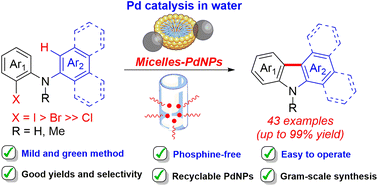
Herein, we present a novel and environmentally friendly method for synthesizing carbazoles relying on palladium catalysis in water as a green reaction medium. The process utilizes surfactant-associated palladium nanoparticles (PdNPs) with DBU (1,8-diazabicyclo[5.4.0]undec-7-ene) for aryl C–H activation of 2-halo-N-arylanilines under microwave irradiation. There, DBU as a base and ligand enhances the efficiency of the Pd-nanocatalyst. The mild method offers excellent chemoselectivity for the C–I bond over other carbon–halogen bonds, and functional group compatibility, enabling the synthesis of forty-three carbazoles, including three bioactive natural alkaloids – glycozoline, clausine L, and clausine H – with up to 99% yields. Here, micelles of the cationic surfactant in water are found to be beneficial for stabilizing the PdNPs, facilitating their recycling and probably limiting the C–Pd protolysis. A simple experimental setup for Pd-catalyzed aryl C–H activation in water, under ambient conditions, use of inexpensive innocuous additives, and avoidance of elaborate phosphine or N-heterocyclic carbene ligands are the obvious features of this approach. Besides being environmentally benign, the present report on Pd/DBU catalysis in water provides a simple procedure and rapid access to diversely functionalized carbazoles.
 Please wait while we load your content...


