


 PLATFORM UPDATE:


One-pot electrode synthesis of synergistic barium zinc oxide/activated carbon for enhanced supercapacitor performance

Abstract
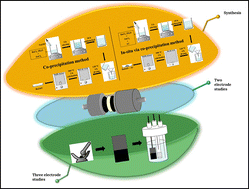
A barium zinc oxide (BaZnO) electrode material was prepared via a co-precipitation method and incorporated with activated carbon (AC) derived from agricultural waste, such as coconut bracts, to form a BaZnO–AC composite for application in energy storage devices. The physicochemical properties and surface morphology of the materials were examined to confirm product formation. The electrochemical performance, such as cyclic voltammetry (CV), chronopotentiometry (CP), and AC impedance (IMP) techniques, was analysed to evaluate the electrochemical activity of the composite material. The results showed that the modified electrode improved the electrochemical behavior and stability compared to the unchanged counterpart. The BaZnO–AC composite exhibited promising performance in supercapacitor applications, attaining a high specific capacitance (Csp) of 1017 F g−1 at 2 A g−1 and retaining a coulombic efficiency of 92.3% after 4000 charge–discharge cycles. The asymmetric supercapacitor device (ASD) exhibited 325 F g−1 at 2 mV s−1 and 190 F g−1 at 2 A g−1. This study demonstrates the development of sustainable energy storage by employing cost-effective coconut bracts as a carbon source, while the integration of BaZnO further improves the material's electrocatalytic activity.
 Please wait while we load your content...


