


 PLATFORM UPDATE:


Illuminating weak bonds: non-classical C–H⋯Br hydrogen bonding and bright emission in a BODIPY fluorophore
 *ab
Mohammed
Obies
e
*ab
Mohammed
Obies
e
Abstract
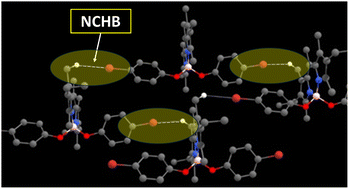
In this study, we report and thoroughly analyze an instance of non-classical intermolecular C–H⋯Br hydrogen bonding in a newly synthesized BODIPY-based fluorophore. The compound was fully characterized by high-resolution mass spectrometry (HRMS), NMR spectroscopy (1H, 13C, and 11B), and single-crystal X-ray diffraction, which revealed a C–H⋯Br interaction with a donor–acceptor distance of 2.79 Å. To gain deeper insight into the nature of this interaction, we employed Bader's quantum theory of atoms in molecules (QTAIMs), which confirmed the presence of a bond critical point and topological parameters indicative of a weak but significant non-covalent interaction. Additionally, Hirshfeld surface analysis and 2D fingerprint plots were used to explore the full spectrum of intermolecular contacts. While other interactions such as C–H⋯π contacts were also identified and discussed, the C–H⋯Br interaction emerged as the dominant force in shaping the crystal packing. This study presents a rare example of bromine-involved hydrogen bonding and offers a comprehensive analysis of the supramolecular architecture in organoboron fluorophores. To rigorously interpret the origin of the optical behavior and state ordering, we complemented TD-DFT with advanced multireference calculations. The results rationalize the small Stokes shift through a rigid excited-state potential energy surface and modest geometric relaxation, and they predict large oscillator strengths consistent with the observed high fluorescence quantum yield. For the brominated scaffold, spin–orbit-coupling-inclusive estimates indicate only minor enhancement of intersystem crossing, aligning with the retention of bright fluorescence.
- This article is part of the themed collection: Articles behind the 2026 journal covers
 Please wait while we load your content...


