


 PLATFORM UPDATE:


Design and synthesis of 2,4-disubstituted thiazole amide derivatives as potential anti-schizophrenia agents
 *ab
*ab
Abstract
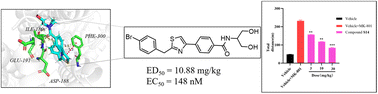
GPR52, a brain-specific G protein-coupled receptor co-localized with D1 and D2 dopamine receptors in key schizophrenia-relevant regions, such as medial prefrontal cortex and striatum, represents a promising therapeutic target for addressing positive, negative, and cognitive symptoms of schizophrenia. Through structural hybridization of known active GPR52 scaffolds (compounds 2 and 7), we designed and synthesized 29 novel 2,4-disubstituted thiazole amide derivatives to systematically investigate their structure–activity relationships (SAR) as Anti-schizophrenia Agents. Key SAR insights revealed that both the hydrophilic head group (critical for target engagement) and hydrophobic tail (governing membrane permeability) synergistically dictated anti-schizophrenia efficacy. In the MK-801-induced mouse hyperactivity model, derivatives S14 (ED50 = 10.88 mg kg−1), S16 (ED50 = 13.84 mg kg−1), S23 (ED50 = 13.02 mg kg−1) and S26 (ED50 = 11.96 mg kg−1) exhibited superior in vivo activity, significantly attenuating hyperlocomotion. Moreover, derivatives with good anti-schizophrenic activity also showed excellent GPR52 agonistic activity in vitro, suggesting a possible association. Besides, the interactions between the new designed compounds and GPR52 protein were studied by molecular docking and the ADME properties of these compounds were also predicted to ensure their draggability.
 Please wait while we load your content...


