


 PLATFORM UPDATE:


Multipolar origin and polarization-controlled high-Q quasi-BIC Fano resonances in dielectric metasurfaces for sensing applications
 ab
and
Ahmed
Zubair
*a
ab
and
Ahmed
Zubair
*a
Abstract
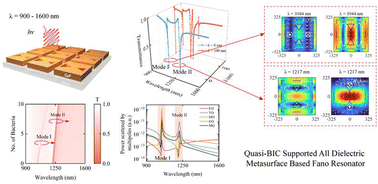
We designed a multifunctional all-dielectric metasurface employing cuboid structures patterned with bow-tie-shaped nanoholes; it exhibits multiple Fano resonances induced by quasi-bound states in the continuum (quasi-BICs) through structural asymmetry. Among them, several resonant modes demonstrated high quality factors in the range of 103–104, along with near-unity modulation depth and strong spectral contrast. The optical responses were analyzed utilizing the finite-difference time-domain (FDTD) method, with Fano profiles fitted to theoretical models and the BIC-governed modes validated via the inverse-square ratio law. Furthermore, multipolar decomposition and electromagnetic spatial field profiles revealed the origins of the resonance, while LC circuit modeling provided additional physical insight into the Fano profiles. The proposed metasurface also exhibited strong polarization dependence, indicating its potential for active optical switching. Finally, the refractive-index sensing performance, including the potential for detecting Vibrio cholerae in an appropriate environment, reached a sensitivity of 342 nm per RIU and a figure of merit of 217.14 RIU−1. Advancing the control of high-Q quasi-BIC Fano resonances, this study highlights Fano resonators’ potential for refractive-index sensing and active switching.
 Please wait while we load your content...


