


 PLATFORM UPDATE:


Diffusion-induced enhanced photoresponsivity and detectivity in an Ag2S/In2Se3 heterostructure for a UV-visible photodetector: an experimental and computational analysis

Abstract
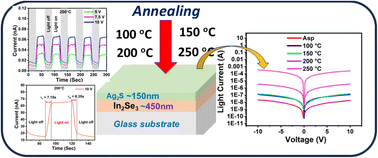
Photodetectors play a pivotal role in recently developed optical communication and imaging systems. Metal chalcogenide-based photodetectors are widely used for visible light photodetection. In this regard, a combined heterostructure of In2Se3 and Ag2S is a promising candidate for visible light photodetection. The annealing-induced Ag2S diffusion into the In2Se3 layer resulted in a high-performance photo detectivity performance of 7.32 × 10⁹ Jones. It showed the highest photocurrent of 62.35 nA during the rise phase and 67.74 nA during the decay phase, coupled with strong Ion/Ioff ratios of 3.96 (rise) and 3.18 (decay). Its rise and fall times (τr = 7.15 and τd = 6.35 s) were moderate and well-balanced, suggesting efficient charge separation and recombination kinetics. The bandgap of the annealed film increased with reduction in structural disorder, as evidenced by UV-visible spectroscopy and well supported by DFT results. The amorphous to polycrystalline phase transformation induced a change in surface morphology and reduced the contact angle, thereby decreasing hydrophobicity. The refractive index decreased with an increase in optical transmission and skin depth, while optical density reduced upon annealing. X-ray photoelectron spectroscopy revealed the oxidation states of the elements, while energy-dispersive X-ray analysis presented the elemental composition of the films. The heterostructure formation and its mixing upon annealing were evident from the cross-sectional FESEM images, and the presence of the planes was confirmed through HRTEM images. The observed optical properties, along with enhanced photodetection, pave the way toward the construction of novel III–VI metal chalcogenide-based heterojunctions for high-performance and broadband photodetectors.
 Please wait while we load your content...


