


 PLATFORM UPDATE:


High reliability Ag/Ni/NiO nanowire-based SERS for cancer detection: a study on breast cancer

Abstract
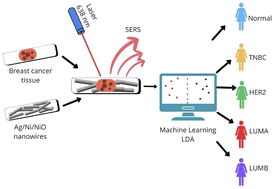
Over the past decade, substantial research has focused on identifying cancer biomarkers using Raman spectroscopy. However, no commercial Raman-based diagnostic tests are currently available. A major barrier is the need to amplify the inherently weak Raman signal, typically achieved through Surface-Enhanced Raman Spectroscopy (SERS). Because SERS relies on nanostructured substrates, its clinical translation has been hindered primarily by poor reproducibility, which undermines data reliability and prevents regulatory approval. In this pilot study, we evaluate an improved SERS substrate based on Ag/Ni/NiO nanowires, previously reported by our group, which significantly enhances sensitivity, specificity, detection limits, and critically substrate reproducibility. We further strengthen analytical performance by incorporating machine learning methods for spectral interpretation. Using this optimized platform, we analyzed SERS spectra from tissue samples of 31 breast cancer patients and compared them with matched healthy controls. Our results demonstrate a clear spectral distinction between cancerous and non-cancerous tissue. More importantly, we showed that SERS combined with machine learning, can differentiate major breast cancer subtypes, including luminal A (LUMA), luminal B (LUMB), HER2-enriched (HER2), and triple-negative breast cancer (TNBC). PCA-LDA modeling yielded exceptional diagnostic metrics, achieving up to 99% accuracy, sensitivity, and specificity across multiple classification tasks. Although this pilot study includes a limited number of samples, the findings demonstrate that improved SERS substrates paired with machine-learning analysis can generate a unique molecular fingerprint of breast cancer and its subtypes. This work opens a pathway for developing assays, potentially using blood or saliva, to enable early detection and subtype identification based on SERS-derived cancer fingerprints.
- This article is part of the themed collections: Nanoscale Advances Covers and Celebrating International Women’s day 2026: Women in Nanoscience
 Please wait while we load your content...


