


 PLATFORM UPDATE:

Antioxidant potential and increased photocatalytic efficiency of gallic acid-capped ZnO and NiO NPs for azo dye degradation: effect of heterojunction coupling and machine learning-assisted modeling
 *a
Umar
Nishan
f
and
*a
Umar
Nishan
f
and
Abstract
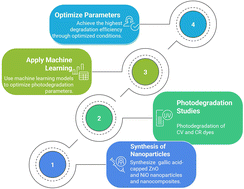
This study presents the synthesis of gallic acid-capped zinc oxide nanoparticles (g-ZnO NPs), nickel oxide nanoparticles (g-NiO NPs), and their Z-scheme heterojunction nanocomposites (g-ZnO-NiO NCs) using a green approach with gallic acid as the reducing agent. Structural, morphological, and elemental analyses confirmed nanoscale crystallinity and uniform distribution, with effective ZnO–NiO coupling in the composite. XRD analysis revealed the minimum crystallite size of g-ZnO-NiO NCs (11.82 nm) in comparison to g-ZnO NPs (28.24 nm) and g-NiO NPs (17.93 nm). Photocatalytic performance was assessed for the degradation of crystal violet (CV) and Congo red (CR) dyes under solar light. Kinetic studies showed that g-ZnO-NiO NCs exhibited the highest degradation efficiencies (95% for CV and 92% for CR), with rate constant values (2.84 × 10⁻² min−1 for CV and 2.56 × 10⁻² min−1 for CR) significantly higher than those of individual g-ZnO and g-NiO NPs. The enhanced activity was attributed to efficient charge separation through a Z-scheme mechanism, facilitating the generation of ˙O2− and ˙OH radicals. Parameters such as pH, catalyst dose, dye concentration, and radical scavengers were optimized, confirming the role of reactive oxygen species in degradation process. Total organic carbon (TOC) analysis indicated significant mineralization (84% and 80% of CV and CR, respectively), and reusability tests showed high stability with a meager decrease of activity (∼6%) over five cycles. Machine learning models, including Decision Tree, Random Forest, and ANN, accurately predicted the photocatalytic degradation process. The antioxidant assay results depicted the higher efficiency of g-ZnO-NiO NCs than pristine NPs and gallic acid, assessed by DPPH, TPC, and FRAP assays. Conclusively, it was emphasized that the g-ZnO-NiO heterojunction is a promising, sustainable photocatalyst for organic pollutant removal under solar irradiation and has better antioxidant potential than g-ZnO NPs, g-NiO NPs, and gallic acid.
 Please wait while we load your content...


